
My children are sad to be done with your Introductory Science course. So am I! It made science so easy this year!
Mrs. L.
It is absolutely no wonder to me that you received this award. I have found your high school biology amazing.
Sami W. and Children
Just wanted to drop a quick note and say how much we are enjoying the Life Science curriculum. Hands down, it is the best program out there.
Ellen K.

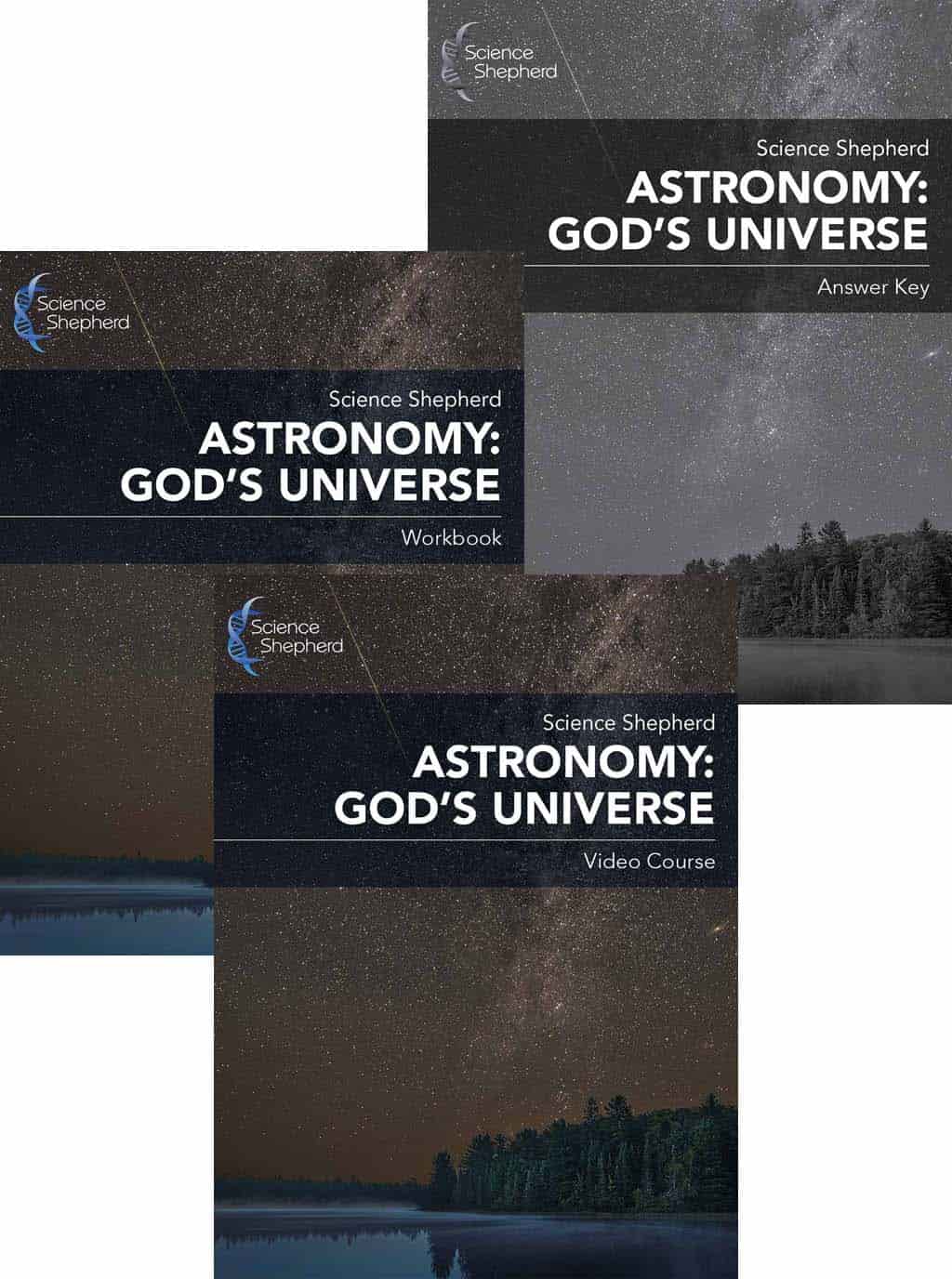
In Astronomy: God's Universe, we've teamed up with Pastor Josh Watson again (Unearthing the Bible) to create a fascinating study of the marvelous work God has created in the heavens.
The heavens declare the glory of God,
and the sky above proclaims his handiwork.
Psalm 19:1
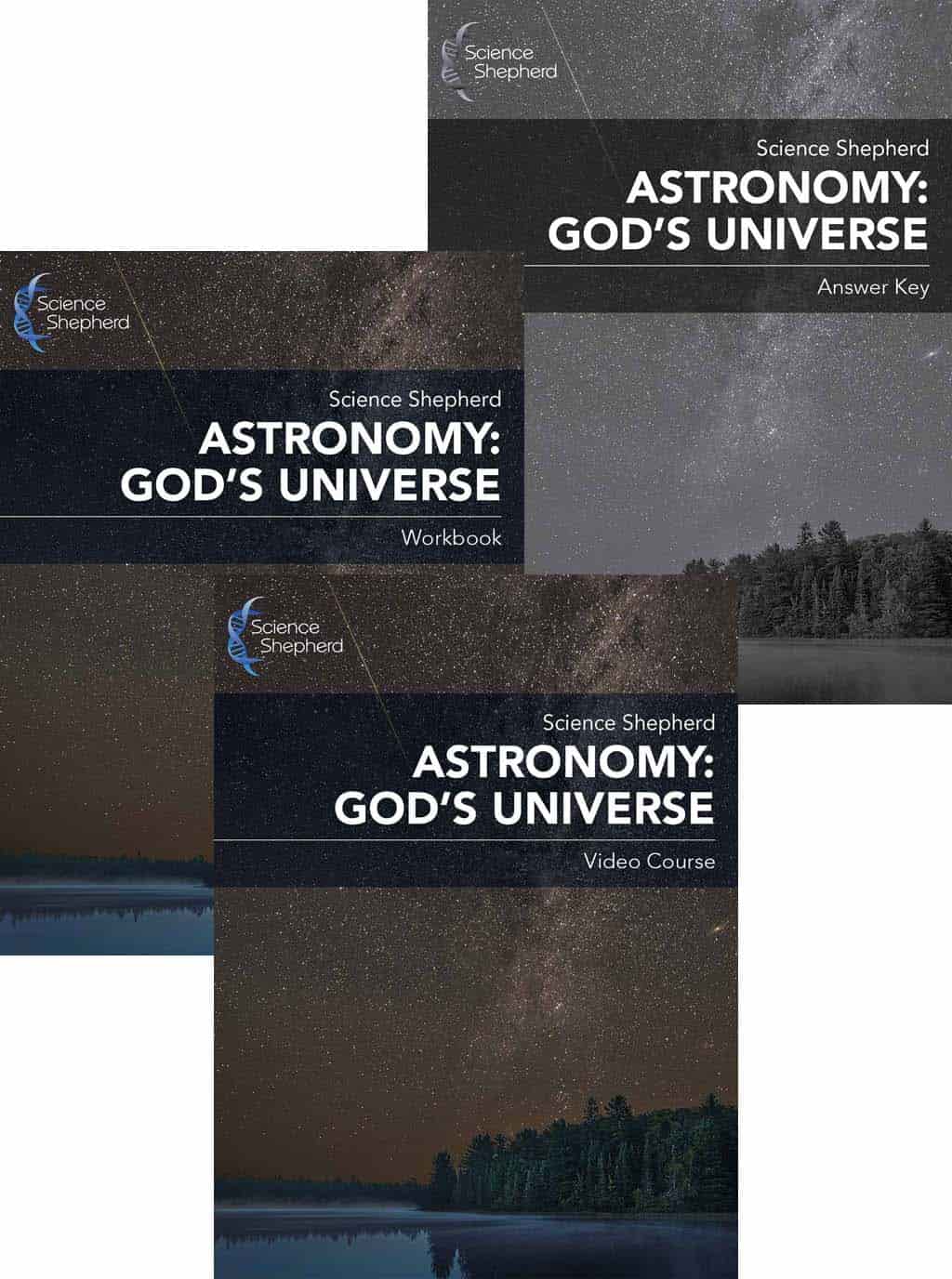
Our homeschool astronomy curriculum for upper-elementary grades and up is video-based (streaming or DVD) with an integrated workbook, just like our best-selling Introductory Science. In Astronomy: God's Universe, students learn about the solar system and planets before venturing deeper into space to explore the stars, galaxies, nebula and more that God has created. Along the way, a special focus is given to discussing the merits of the creation and big bang origin models to clearly show that - scientifically - the big bang model fails while the creation model is consistent with astronomical observations.
The Astronomy: God's Universe Video Course is offered in two tracks - Level A and Level B - to help you tailor the learning experience to your student(s). Level A includes 66 lessons, with over 7 hours of content, and Level B features 95 lessons, with over 11 hours of content (all lessons from Level A, plus more). Level B students encounter more detailed discussions in select topics such as binary stars, dark matter and energy, relativity and more. Each Level is presented in an easy-to-follow, 36-week schedule that is great for independent study.
As part of each Astronomy: God's Universe video lesson, students complete workbook assignments to help reinforce key concepts. In addition to including content for the extra Level B video lessons, Workbook Level B is written to be slightly more challenging than Workbook Level A. Optional hands-on activities are included in both workbook Levels.
These recommendations are flexible and meant only as guidelines. When selecting the right Level for your student(s), consider their reading level and critical thinking. The free course preview and Workbook samples can also help you choose the appropriate Level (see below).
Enrolling multiple students? If you will need Level A and Level B material, simply purchase an Astronomy: God's Universe Level B bundle and add additional Level A Workbooks and an Answer Key as needed.
Science Shepherd is a HowtoHomeschool.com Best Homeschool Products & Curriculum of 2023-24 Award Winner, a 2022-2025 Homeschool.com Educational Website Awards Winner, and receives rave reviews from families. You can be confident that our homeschool astronomy curriculum will provide an excellent educational experience to your student.


Watch a sample lesson video below, or access a free preview of our homeschool astronomy curriculum through our online student learning portal. The preview includes 3 complete lesson videos and the corresponding pages for Workbook Level A and Level B so you can easily compare and select the right Level for your student.
Ready to explore the heavens? Save 10% on our Christian astronomy curriculum bundle!
First of all, I wanna welcome you to this course called Astronomy God's Universe. We are glad that you are joining us as we explore another field of science. At Science Shepherd, we believe that every field of science is very important, and that's because every field of science is an opportunity to be amazed at God's creation and how it works. And that's certainly true when it comes to astronomy because with astronomy, we're dealing with very, very large objects way out in space and very immense distances in between all those objects. Before we get started though, let's first clarify what exactly we're talking about when we use the word astronomy. And the reason is sometimes there are misconceptions or misunderstandings when people say astronomy. So I just wanna make sure that we all understand what astronomy is and what astronomy is not. The word astronomy actually comes from two Greek words. The first word is astron, and the second word is namas. Now, astron is the Greek word that means star, and namas is the Greek word that means law. So if you combine these two words, the word astronomy literally means the laws of the stars or the truth and fact about stars. Which means that basically astronomy is the area of science where people study and observe the different facts that we can learn about the stars and all the other things that can be observed out in space. You know astronomy focuses on things like what the stars are made of and what we find around them and how far away the stars are from us and what you call a collection of stars and how big the stars are and the forces that act between objects in space and on and on, things like that. That's what is meant by the term astronomy. Now the reason I wanna be so clear about this from the start is because sometimes people confuse the word astronomy with another word that sounds almost the same, but is actually very different. It's the word astrology. Astrology is different in the fact that it doesn't focus on facts. Instead, astrology is when people look up at the stars in the sky and where they are in the sky, and then they try to find some hidden message from the stars. You know, a message about who we are, about how we should live our lives. And as you can see now, that's very different than dealing with the facts about stars and other objects out in space. And astrology, it actually also comes from two words. The words are astron and logos. Of course, we already know that astron means star, but the word logos means word, you know, or thought or reason. So astrology is when people try to understand or, you know, reason and find a word or a message that the stars are telling them. It's as if they want to know the thoughts of the stars or or what the stars are trying to communicate to them, As if stars could talk or think. Of course, we know that if you want to learn the truth about who you are and how you should live your life, you shouldn't be looking at the stars. They won't tell you anything. Instead, you should be looking at God's word. The Bible tells us the answer to those questions. But just to be clear again, in this class, we are going to study astronomy. The laws about the stars. The facts. The truth about the amazing things God created in the universe. We are going to learn a lot and you are going to be truly amazed at the incredible things that we discover out in the vast universe all around us. For me personally astronomy is my favorite field of science. I've always been amazed at how immense the universe is in size and how amazing to think of a number of stars that are there out in space. And especially it's amazing, you know, to me to think about how after so many years and so much technology that we now have, there's still so much about the universe we don't know yet and how we're always discovering new things. To me, that's fascinating. And so it's my hope that as you go through this class on astronomy and as you learn new things about our universe, you will gain an even greater interest and appreciation for the field of astronomy than you've ever had before. And hopefully, at the end of it all, you will be even more certain than you've ever been that there is only one explanation for how such an incredible universe came into existence. A powerful creator made it all.
Level A of Astronomy: God's Universe includes 60+ video lessons. Level B contains those same lessons, plus over 25 additional lessons. So, Level B is a longer course than Level A. These additional lessons provide more advanced study in the areas of dark matter, dark energy, relativity and more. In addition, the Level B Workbook is more challenging than the Level A Workbook.
No, Astronomy: God's Universe does not have any tests or quizzes. If you would like a cumulative review of material for your student(s), we recommend using the crossword puzzles in the workbooks, which review material from several recent classes.
Since these are science courses that were written by a Christian, probably the most common question I am asked is, “What about evolution and creation?” The answer really starts and ends with the Bible. It is the unerring Word of God and, as such, provides the framework upon which everything is understandable, including science. As such, all Science Shepherd material is presented from a literal understanding of Genesis, teaching that God created the universe and everything in it in 6 literal, 24-hour days, about 6,000 years ago. Now, why evolution in Christian-based courses? It is important to cover evolution and some basic principles because our children will be constantly bombarded with it throughout their lives.
Looking to plan a few years in advance and have your next topic selected? We recommend our Life Science homeschool curriculum as a follow-up to Astronomy: God's Universe. You can also read our "Recommended Course Progression" blog post for a broad overview of utilizing Science Shepherd curriculum in your homeschool.
December 29, 2025 5 min read
Science for 7th grade.
December 20, 2025 5 min read
Homeschool science for 6th grade.
Subscribe to our newsletter and we'll send you a code for 10% off an order
plus a free download of 5 Scientific Ways Your Kids Can Defend Their Faith.