
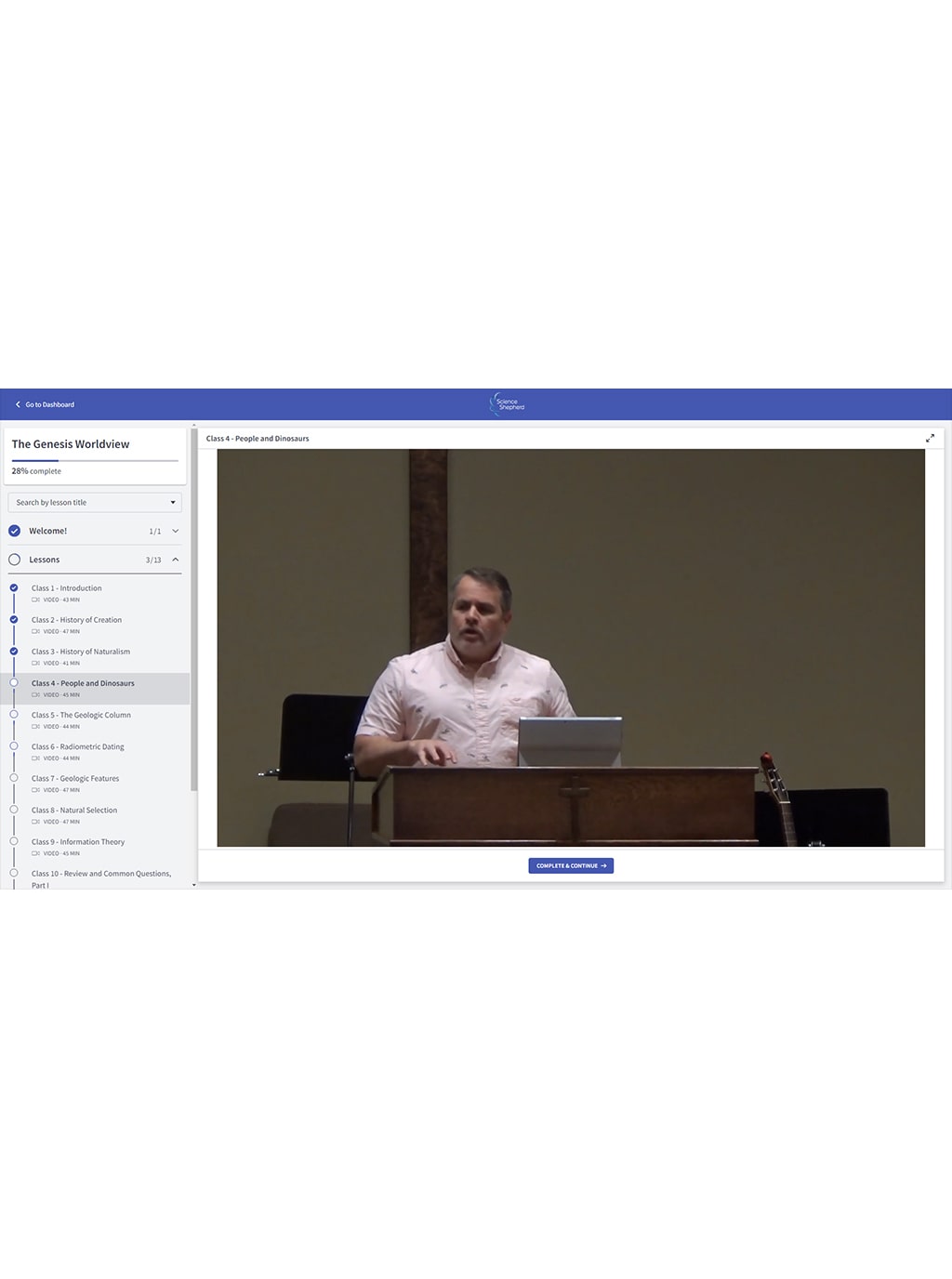
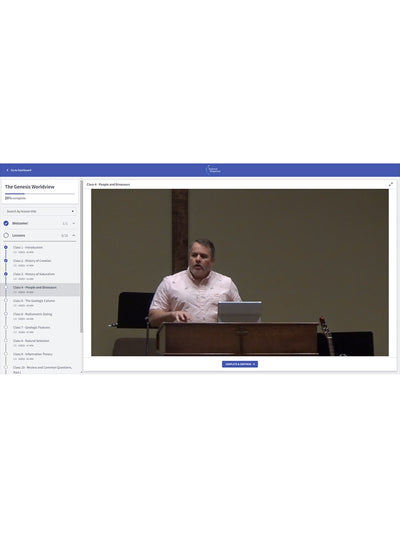
The Genesis Worldview is a multi-part video series from Science Shepherd author Dr. Scott Hardin that explores Scripture, science and creation to show that science supports Scriptural sufficiency. Over 13 lessons, Dr. Hardin shows that all areas of science - from the geologic column to radiometric dating, information theory, cosmology and more - support a literal interpretation of the Genesis creation account.
Interested in learning more about science and creation? Check out these free resources!
Science Shepherd Homeschool Curriculum was developed by Dr. Scott Hardin, a homeschool dad and physician, to provide a curriculum for the homeschool community with a biblical perspective of science and creation. Since starting with Life Science and Biology to aid parents in homeschooling through the higher grade levels, Science Shepherd has grown to included courses at all age levels. Visit our Recommended Course Progression blog post to find the right material for your family.
Science Shepherd has been awarded multiple Practical Homeschooling Reader Awards, Homeschool.com Educational Website Awards, and receives rave reviews from homeschool families. You can be confident that our curriculum will provide an excellent educational experience to your student, deepening their understanding of science and creation.


Since these are science courses that were written by a Christian, probably the most common question I am asked is, “What about evolution and creation?” The answer really starts and ends with the Bible. It is the unerring Word of God and, as such, provides the framework upon which everything is understandable, including science. As such, we believe and teach that God created the universe by simply speaking "Let there be . . .," just as God told us in the book of Genesis. Now, why evolution/naturalism in Christian-based courses? It is important to cover evolution/naturalism and some basic principles because our children will be constantly bombarded with it throughout their lives.
All Science Shepherd material is presented through the straightforward interpretation of Genesis, so a "young earth" point of view. Depending on the class, old earth creation may be addressed within the context of affirming the sufficiency of Scripture-- the Bible is the inspired, inerrant Word of God. Since He used historical Hebrew language structure to write Genesis, it should be understood as written, leading to the conclusion that God created the universe and everything in it in 6 literal, 24-hour days, about 6,000 years ago.
Watch the entirety of part 1 of The Genesis Worldview without needing to enroll! In this lesson, Dr. Hardin introduces the basics of what a worldview is and why it matters to the discussion of Scripture, science and creation.
Okay. Well, I am really pretty stoked to be here because it's, a lot of fun to talk about things that you like a lot, that you are interested in. I've been in interested in this for about fifteen years and have come, some way in my understanding of this, but I have a long way to go. And I really I just I wanna have a real short prayer before we start, and then we'll get into it. Very simply, Jesus, more of you and less of me. If, any words are remembered, may they be yours and mine forgotten. Thank you, Jesus. Amen. So, before we begin, I just I wanna make sure that we stay very well rooted in something. It's a very, important concept because I've talked about this a lot over the years in different places, even different states. And a very common concern sometimes arises depending on where people are in their own minds. And that concern can be, one of, some issues that we're gonna talk about raising questions about salvation. Are you really saying, for example, if I don't believe that the earth is six thousand years old, are you saying that I'm not saved, that I'm not a Christian? If I don't believe that Noah's flood was actually real, a worldwide cataclysmic event like the Bible describes, are you saying I'm not a Christian? And I am no. That's absolutely not what I'm saying, because this is what defines us as Christians. Because if you confess with your mouth that Jesus is lord and believe in your heart that god raised him from the dead, you will be saved. For with the heart, one believes and is justified and with the mouth, one confesses and is saved. That's what defines us as Christians. But what I would very clearly say is that there are, some very reasonable contradictions, dichotomies that are raised, if you as you're looking through the Bible, there are some very, serious theological issues that can be raised, when you are, really in my mind, when you're trying to compromise man's idea that the earth and the universe are, is billions of years old and God's idea, I think what is very clear in the Bible, that it's maybe a few thousand, six, seven thousand years old. And that's really going to be the focus of where we're at. There's some, there's some illogical conclusions that you have to come to, both in biblically. And then there's a lot of scientific, problems with, with believing that. And that's really what I'm going to be spending a whole lot of my time talking about here, are both the, the ill law, the, the contradictions that can come up in the in the biblical aspect and the theological aspect and the, the scientific problems with not believing, that how God wrote Genesis as actual historical narrative is true. And and we'll we'll be getting into that. That's really what we're gonna spend a lot of time on here. So I'm sorry. I'm trying to coordinate two different, two different things here. So, my objective really in a nutshell is just that to show that, Sola Scriptura is is not undermined by anything the science, tells us, by any scientific fact that exists. God, after he spoke long ago to the fathers and the prophets in many portions and in many ways in these last days has spoken to us through his son, whom he appointed heir of all things through whom he also made the world. And that is that goes right back, obviously, to Genesis one one in the beginning, talking about Christ's involvement in that from the beginning, Jesus was the word. The word was Jesus. So we're we're gonna really dissect a lot of stuff to understand why it's very reasonable to, to believe the Bible as it's written and also to learn that there are no scientific facts that dispute that dispute, the a very straightforward reading, and understanding of the Bible. And this is, even for the older folks, for the younger folks, for the students, This is in many ways providing a defense. And to me, providing a defense for what we believe is truly understanding why you believe what you believe. It doesn't do you any good to believe something because you were told that you should believe it. It the only way that it makes sense that it will make sense to you is, that you believe it because it's yours. And, is that to say that looking at the age of the earth, for example, as, as actually being six thousand years old, is that to say that when you believe that everything makes sense? No. There's some scientific issues that we will talk about. Is this a perfect thing? No. Because God is perfect, and he knows how he did everything. But there's some things there are some scientific aspects of believing the earth is six thousand years old that are challenging for for, for a Christian just as there are many, many problems with evolution with, how, how when the earth is old, how did that happen? Why are some things still as they are? For example, why have the earth and the moon not hit each other yet? Because if you unwind, scientifically, if you unwind, the earth how far away the earth is from the moon, you find because the moon we know the moon very slowly gets closer and closer to earth. And if you unwind that into the past billions of years, eventually, the moon gets too far away to be captured by the Earth's, orbit. Or if it starts in the Earth's orbit, they should have hit a long time ago. That's very simple astrophysics. That's not rocket science. That's very simple astrophysics that you can't argue with. And so we're gonna talk about a lot of these things, and and get into it much more. But, ultimately, it's all about providing a defense for what for what you believe. So in an expanded way, these are the things that I'm gonna be talking about throughout the course. We're gonna learn that the Bible is true from the very first in the beginning, the Genesis worldview, and we're gonna look at why is it reasonable to read Genesis as actual historical narrative, not as a really interesting story that is kind of an allegorical description of how, God breathed life in into man two hundred thousand years ago, but that it's actually, should be understood as historical fiction because it appears that that's how God wrote that wrote wrote it at the time. We're gonna look at how the Bible is written as being very important to understanding what God's intentions are. The Genesis and we're gonna learn very clearly that the Genesis worldview was the norm until really about a hundred and fifty years ago, maybe two hundred years ago. It that was the norm for all scientists, for all, people, at least those that had thought about it and were brought up in a in a Christian background, that the the Earth being, quote, unquote, young at six six thousand years old ish, that was normal. That's how everybody looked at the Earth. There was never, very rarely was there question to that. We're gonna really clearly understand why that changed because the reason it changed was not science. The reason it changed was doctrinal, was political, was, philosophical. It was the reason that it changed was specifically to remove God from science. That was the original intention of evolution of the millions hundreds of millions, billions of years old, situation. That was specifically a the objective to to introduce that to introduce that. And we're gonna look at a lot of different old earth and young earth models. So when I say old earth, I'm talking about billions of years. When I say young earth, I'm talking about about six thousand years old, belief system that the earth is is about that old. We're gonna look at those and, see that the Genesis worldview so that and when you hear me say Genesis worldview, please understand that I mean a straightforward reading of Genesis as it is written, whether you're talking about in the ancient Hebrew or as it's been translated, into English, that is written as historical narrative as it would be if you were telling somebody what you did yesterday. It's written in that same in that same narrative. And so we're gonna look at that, in some depth to understand that, the Genesis worldview not only is, is, invalidated or is validated by science and then kind of flip that around and look at what the science tell us, of, the the old view, the the view that the earth is very old. What does science tell us about that, if if we choose to interpret scripture as being more allegorical, more of a story, what does what kind of problems do we run into? There are some some serious theological problems that you encounter. Yes. You can you can get around them, but it takes a lot of gymnastics to get around them. And we're gonna talk about, we'll talk about that as we go through this, what, what what I mean by that. So these are some of the things that we'll be talking about, and then I I have the the next ones. Is this the juicy one? Yeah. Okay. So the juicy things for me are the things that people, a lot of people can't believe that I actually believe and other people actually believe. So we're gonna we're gonna look and see that multiple branches of science provide irrefutable evidence that the Earth is not old. Billions of years are not necessary to explain the things that we that we see today, the biodiversity, to explain mountains, valleys, erosion. We don't need billions of years for that. It's it's a there are multiple branches of of science that that, that prove that. Dinosaurs did not become extinct millions of years ago. People and dinosaurs lived at the same time. And I I will show you what I think, is irrefutable evidence that that is true, because if we never lived at the same time, there are some things that should not be possible, if that was true. There there are things that should absolutely not be possible, but yet we find them. And we'll talk about that. And and, really, all it takes is one thing to irrefute a a particular tenant to make the the whole thing crumble. And, this this evidence is out there. I'm not saying it's suppressed, but it's certainly not talked about in any science classes. We will see very clearly that the, geology shows proves that the Noachian flood was a real event. It was a real worldwide cataclysmic event because there are some geological findings and facts that cannot be explained any other way. Yes. They try to explain them other ways, but you can't you just can't do it. We're gonna see that radiometric dating as, as applied in the secular world is a farcical misappropriation of scientific principles. Radiometric dating is, probably the number one reason that people say, well, I guess the Earth is old. Science tells us it is. They take this rock sample, and they put it in this machine, and it says it's a couple billion years old. That's a bunch of baloney. There are multiple multiple assumptions that go into radiometric dating that we're gonna talk about so you clearly understand why I'm not a whack job to think that dinosaurs and people live together, to think that the Earth is not old, and to think that, radiometric dating, is really not. It's based on real science, but the conclusions are are far, less than objective objective. So we got some more. So we're gonna talk about, information concepts, information science. This is something that's been around since about the late fifties, early sixties since Claude Shannon, invented the computer. He didn't invent the computer, but he invented the way of thinking about information that allowed the computer to be, made. So information science has been advanced significantly over the last, thirty or forty years. And, when you look at, the genetic code from an information standpoint, what is the genetic code? That's how we're built. That's how every organism is built. That's how every organism knows to do what it's supposed to do. It is a massive information library, five hundred, fifteen hundred page, book equivalents for human beings. That's information. How did that how did that get there? There are some information tenets, that nobody has ever disproven, that were forwarded by a creation scientist that clearly prove that you can't have information arise accidentally. We're gonna look at rational biblical deductions, genetics, information science that's, that support the, quote, unquote, old ages in the old testament. This is, somewhere where I like to emphasize that, the Bible is not a science book, is it? And that's, there are, I get in a lot of discussions with, some old earth creationists that, listen to this. The Bible isn't a science book, and it's not. It absolutely is not. But that it talks about history. It talks about how God did things. It talks about events that actually happened from an eyewitness standpoint. I mean, who better than God to tell us what how he did things, what he did, how we got here, etcetera. So there are very rational deductions that you can see when there are consistencies throughout the Bible that talk about certain things happening, certain things not happening that way. Like, for example, if God used evolution to get us here, why wouldn't he have told us that? That's not what he said he did. So he so then he lied to you know, God doesn't lie. Right? I mean, God God cannot lie. So if he didn't use evolution or if he used evolution, why did he tell us a mechanism of how we got here, that he created us and we reproduce after our kinds, which means people only ever make people, amphibians only ever make amphibians, reptiles only make ever make reptiles. Why did he tell us he did something if if if he did it a different way? And, again, there are serious biblical and theological, concepts that are raised, and we're gonna get into these, to see that science supports fully supports the bible, in understanding that we have not been here for a long time. We're going to look, and see is it going? Yeah. Okay. So we're going to look and see, where the Bible makes several outcomes, of trying to mold the science and the Bible together, be as very untenable. This is kind of the day age theory, progressive evolution, things like that, progressive creation. We'll get into that to understand why, again, there are problems when you try to mold a man made idea with what God says he did. We're we can look at popul we're gonna look at population science, which absolutely refutes human beings arising two hundred thousand years ago. This this is there is no you cannot argue with this. Of course, people do, but it's very difficult to argue with population, science, and and population growth numbers, to say that things did not happen as they did. We'll see that, actual observational studies. This is observational science where you're in the field observing things, provide clear evidence that thousands of years or less is plenty of time for the biodiversity that we see on life to develop today. So we don't need billions and millions and hundreds of millions of years, that that, that evolution proposes, that the secular idea of evolution, proposes. And we'll talk about a lot more stuff. So I just wanted to make sure that you guys see because today I'm really gonna be focusing more on, on the introduction of why are we here? Why am I standing here, talking to you about this today? And I wanna reemphasize that this is not a, a course on questioning your Christianity if you don't believe what I'm saying. What I'm here to do is to push your limits to provide, I hope, rational information, rational and coherent discussion about, a worldview that is based upon the bible being the inerrant word of God in everything that it says, and that there is nothing in science to compromise that belief. So if you're struggling with this, I hope this will help. If you don't believe what I'm saying, I hope I question you. I hope I cause you to question yourself. I would hope that I don't get you really honked off at me. But if I do, come and talk to me because I I love talking about this. And sometimes people will say things to me that I don't I've never even thought about before. But this is still this is what defines us as Christians. So please keep that in mind that as we go through this, I am not at all, it is not ever my intention to question, your Christianity or salvation if you don't believe what I'm selling. So I wanna talk a little bit about why I'm here talking about this, in the beginning. I'm gonna talk about what a worldview is and why it's important because a lot of people don't really even think in that way. Many do, but a a whole lot don't. I can tell you, from talking about this and having people come up and talk to me and saying, gosh, I never even thought about what a worldview is before. That was really interesting. So it's been, for me, interesting to hear that. And we're gonna set the foundation that many of our brothers and sisters, we're gonna see that many of them have lost their view. Even people that don't realize that they have and would and would if I ask them, why do they believe what they believe, they would say, oh, I believe it because the bible says. Do you really? And let so we're gonna get into that before we're done. So I just wanna talk a little bit about how I got here, because my pathway was not one of, yes, I believe the Bible and everything in it, and that's how I learned science. I didn't know the Bible when I was growing up. I was not a Christian. I was raised in more of the cult of Christian Science. We were not heavy practitioners of it, but I had no exposure really to the Bible or, holy people. My my, real exposure to, to anything having to do with religion was one of, my my best friend that lived across the street was Catholic, and my best friend next door was Lutheran. And I got to enjoy them arguing about, was Mary holy? Was Mary not? Do you pray to Mary? Should you? I didn't have no idea, but it was always very entertaining because it usually ended in a fist fight. But, yeah, that that was okay. So that I had I had nothing. I had no I had no skin in the game, right, for this this whole Jesus thing. I I had nothing I had nothing going through school. Obviously, I'm a physician. I was interested in science. So the more that I got through school, the more I became indoctrinated into the lie that is evolution. And I think that a lot of people, a lot of my teachers honestly believed that it was true, and they taught me, as if it was true, but it's not. And, ultimately, it's a lie. And the people I believe that the people that set all of the science agenda so these are folks that, are members of the National Academy of Sciences. About ninety five percent of them are atheist or agnostic. If you're an agnostic, I don't think it's really any different whether you're an atheist or not. Your point is you don't believe in God. So how can God be part of anything that you said? How can it be part of any agenda, educational agenda that you set for the high schools, for the, colleges? They're the ones that write all the textbooks. So, of course, there's not gonna ever be any meaningful discussion about anything other than evolution. So by the time I got of out of undergraduate, you know, I came out of high school, never questioning evolution. I went into, my undergrad at UWM in biological sciences, evolution, evolution, evolution. I had I had no reason to question it because that's what we were taught. Once I got into medics so I graduated undergrad as, as a committed evolutionist. I didn't think about it like that. Why would I? I never questioned what I was being taught. I learned it, but I never questioned it, which is very unlike me. And, I took I had a year off in between undergrad and medical and medical school where I did, I worked in the bone marrow transplant lab at the medical college, not so much evolution based. And that's the other thing that, you know, evolution is completely irrelevant to practicing medicine yet weird. That's what we're taught. But I practice I I worked for a year in bone marrow transplant lab, doing clinical and, bench research. So, I mean, I understand what it what it means to to to be a scientist. And some people and I'm gonna get into this, a a little bit more. But some people look at, doctors and say, you're not even a scientist. How can you do this? If you have a doctor that doesn't think he or she is a scientist, you should go find some another doctor because that's, that's what we do. That's how we're taught. So, in medical school, we our first year is very heavy in, anatomy, physiology, biochemistry, organic chemistry, and genetics. And at, one point during, my first year, it was either my first or second year either in genetics or, you know, advanced genetics. We they were talking about evolution, talking about how evolution occurred. It's supposed to occur through mutation. And, if any of you know anything, I'm gonna get into this as we go through this course. But if you know anything about mutation, you know, that all it does is damage information. It damages your chromosomes. It damages your genes. It's like going, to a book and ripping out a couple pages. Mutation doesn't add stuff. And if you think about it from, if you're a bacteria, so you're a single cell bacteria, that's how life all was supposed to start. It has a very tiny amount of information in it. We have, many millions of times the information in our genome, our set of genes that make us people compared to a bacteria. So in that evolutionary line from a bacteria with hardly any information to us with tons of information, there has to be a mechanism to make that information arise. And that's supposed to be mutation. And I thought, well, that doesn't really sound like it makes a whole lot of sense since we know mutation damages stuff. So I went and I talked to one of my genetics professors who was sitting around with a couple of his other buddies eating lunch, and I said, hey. You know, I don't I don't get this whole, this whole mutation thing adding information. How how does that how does that work that that these random events that we just learned damage all of our damage our chromosomes, damage our information, how does it make new information? So I asked him a scientific question. That is a scientific question that should have a scientific answer if this is right. And his answer was, are you a creationist? Like, dude, I don't even know what that means. I just asked you a scientific question that you cannot apparently answer. You cannot apparently answer for me. So he answered my scientific question with a philosophical response. That is a very bad, that is a very, bad outcome for somebody who is now incredibly analytical, looking at data, showing what it what does it show me? What does it mean? What does it not? What do I do with it? So that was a very bad thing. So I I was kind of at that point, I I was, essentially, now I don't know where I am in in in the world because there's no mechanism that explains how I got here. And I'll I'm not gonna get into this, but fortunately, my wife was, was moving from a Catholic church to more of a a fundamental bible church, and that is that's how I ended up here. But I it it was a it was a long road, okay? It was a very long road. I went through a lot of stages once I figured out, clearly that evolution is a bunch of baloney and there's because there's no mechanism. If there's no mechanism, it can't happen. And so I, went through a lot a lot of stages, but ultimately, for me, I I was I had no, previous understanding. I just I started reading the Bible. That's like the instruction book. Book. Right? My wife's going to church. I always went to church with her, the Catholic church. And, you know, it was never really very Bible heavy. But then after we started going to, a Bible church, we started reading the Bible. So I'm just reading. I'm soaking this stuff up because here's the instruction book from the guy, I guess, that wrote it. Apparently, God wrote this thing. So I guess he's telling me how he did stuff. And, it took me a while, but like I said, I finally I finally got here and went through a bunch of stages. But what I really want to emphasize here is that yeah, is the scientific background, of of physicians. We are trained to look at empirical evidence, synthesize it in our brains, and then spit out a treatment for a patient. And, so it to me and and I don't mean to to denigrate, any PhD scientists that are doing bench research and things like that. I mean, we need that. But when I when you misapply, bench research, you can kind of stand back and, oh, I made a mistake. We can do it again. If I misapply scientific research to people, sometimes they end up dead. And so the stakes are very high. When you are a physician, you need to make sure that you understand the data, that you know what it's telling you, that you know your patient and you imply, your scientific, process very clearly to, to treating your patients. So this is really that's we spent four years, in medical school doing that, four years of residency doing that. And then since I've been out, I've been doing it for twenty years. So I spent a long time thinking like scientists. And this kinda led me to what I've got up there as our little side business. About twelve years ago, we wrote I wrote a book, a biology textbook, creation based biology textbook, because I thought maybe I could do it better than the stuff that was out there at the time for homeschooling. We homeschooled our kids, for over twenty years now. And, I wrote I wrote a science, high school biology textbook because I was very interested in this. This caused me to get a whole lot deeper and deeper than I, ever expected to into this whole creation thing. And that's grown very nicely. I've we've added courses over the years. So so I've been steeped in this, not only in being a scientist, but, but joining science and the bible together for a very long time. And, that's that's why I'm here, and that's, I hope what I'm gonna be able to impart to you. So let's get into the Genesis worldview. So what is a worldview? I mean, have you ever thought about this? Like I mentioned before, some have, some haven't. But very simply, it's how you see the world. And, people don't, like I said, people don't really realize this a lot, but, we'll go through a couple of examples to so you can see what I mean. So what worldview is this? You know, what's this picture showing? Yeah. The rose colored glasses. Everything you see looks great because you look at the world through rose colored glasses. So that every when you hear that, you say, oh, wow. This is like the eternal optimist. That's great to be, sometimes irritating for your friends and neighbors. But, the the, the rose colored glasses, that is simply a description of a worldview. So what worldview is this? It's a glass half full, half empty kind of guy. So the pessimist looks at that and says the glass is half empty. The optimist says, well, hey. The glass is half full. But in reality, they're all full. Right? It's just depending on what you think they're full of. So they're half full of water and they're half full air, but they're all full. So that's the reality, and that's what I wanna be able to do is to pick apart the reality here of what we're talking about. So here's another famous, picture. What what is this? Not my kids. What's that? Yeah. So what is this event depicting? This is a John Trumbull picture, the biographer, the the painter of the of the, war for independence. So this is this is Cornwallis surrendering to Washington. And I think most of us look at this and say, yay. But what if you were British? Cornwallis wasn't saying, yay. Cornwallis was so upset. He wouldn't even go out on the field, and have he didn't even have the honor to surrender to, to Washington himself. Same fact. Same exact fact. We just kicked their little bottoms and but very, very different understandings, very different processing of that event. And this is probably my favorite. So there are two distinctly different views when you look at, the civil war or the war of northern aggression. If you're the southerners, there's very, very different views of this. Same fact same fact Same facts that were exist existent. Some people choose to look at all the facts when they form their opinion about the Civil War. Some people don't. And I really wish Caleb was in here. So again, that this is a fact. Right? This is there this is a factual, information that your brain is receiving. If you're a Packer fan, you think this is great. And if you're a Bears fan, you're whimpering in the corner like you usually do when you play the Packers. And so here's one. So this is very polarizing. I love showing stuff like this too, because it makes people a little nervous. What am I going to do? So if you're like a Trump guy or gal, you this is good. Here's but if you're not, it's not so great. Right? It's the same fact. It's the same fact, but we process it. We form opinions in a very different way. And so that is really all that a world view is, is we all have these filters that make us determine every single emotion, thought, decision, and action that happens around us. So I wanna see if this will work. Can you can you run that video for me? And before we run it, I just want to make sure that everybody understands I am not showing this. This is this is produced by the Catholic church. I did not brand this. This is available on YouTube, and I'm not showing this to slam the Catholic church, whoever the dude is that's going to be talking in here. This is just, this is to me, why we are here in two minutes. Protestants believe the Bible is the only source for determining Christian truth. This doctrine is called sola scriptura, which is Latin for scripture alone. But did you know that this fundamental doctrine of Protestantism is incoherent? Let me explain. Notice the doctrine presupposes knowledge of what scriptura is, those books inspired by God that belong in the Bible. But if the Bible is the only source of Christian truth, well then we couldn't have such knowledge. Why? Because the Bible never tells us which books are inspired. If Sola Scriptura were true, well then we couldn't know what scripture is. Do you see how it's self refuting? Even if the Bible did give us a list of inspired books and we believed the Bible was inspired, well we couldn't accept that list lest we'd be guilty of circular reasoning. For example, why do you believe the biblical books are inspired? Because they say they're inspired. Well, why do you believe them when they say that? Because they're inspired. The only way to acknowledge the inspiration of scripture and avoid circular reasoning is to appeal to an infallible church established by Christ that tells us which books are inspired. But Protestants reject this idea, which gives rise to another conundrum. If no infallible church exists and Protestants believe our knowledge that the biblical books are inspired as infallible, well then we would have an infallible effect produced by a fallible cause, which is absurd. The bottom line is sola scriptura is an unreasonable doctrine. So of my Protestant friends I ask, why believe in a doctrine that can't stand up to the scrutiny of reason? So what you need to do is to look at the experts for a list of the inspired books. So the tenet here is that none of the none of none of us are capable of intellectually understanding which books are actually inspired by God, which are not. And we need to look at other people, other experts to tell us that. And so what have we done now? We've subjugated our understanding, of the Bible. The Bible is meant to be understood. We're gonna talk about this. It's called the perspicuity of scripture. It's meant to be understood. That's very clear. And so this is why we're here. We are substituting man's understanding of the Bible for God's, what God is clearly telling us. So we can we can stop that. That's it's too bad we didn't have it because it's like, oh, man. I've actually never even heard that before. I listened to this. So that's really where we're why we're here because we have we have, subjugated our understanding of the Bible to to man. So there's generically, we've got two types of worldview. We've got what I have called a Christian worldview or the Genesis worldview where all of the bible is the inspired word of God and it is able to be understood, and believed as actual truth. And then we have the secular understanding, which is what, that fellow was talking about, ultimately was man defines the truth. So we're we're delegating our understanding of the Bible, to a group of experts. That is always a scary thing, by the way. Whether you're talking about the Bible or anything, do your own research because you are smart enough to figure it out. So that's the two worldviews. We got the, really, the the Genesis worldview, and the non Genesis worldview. So the Spartan's research group was really interesting, and they do a really good job. They kinda understand, religion and and theology, and they asked several different questions. And woah. Alright. Everybody lay down on your right side. So they asked several different questions to, people in the church. Do absolute moral truths exist? Is absolute truth defined by the Bible? Did Jesus Christ live a sinless life? Is God the all powerful and all knowing creator of the universe, and does he still rule it today? Is salvation a gift from God that can be earn that cannot be earned? Does a Christian have a responsibility to share his or her faith with others? Is Satan real, and is the bible accurate in all of its teachings? Those questions, as you heard them, I think most of us might think, yeah. I I agree with all those. So let's, let's see what Oh, okay. So I'll keep going. But what happened was what they did is they looked at, the responses of people of just Americans. They just went across the board. They didn't try to get anybody particularly that was religious or not. They just went across the board, and then they started putting people into categories. What they found is that, seven percent of the people who identified as being born again and less than one percent of all Americans answered all of those questions yes. Seven percent of those who said they were born again said that they there is an absolute moral truth and it's the bible and it's accurate. Truth is defined by the bible. Jesus was sinless. God is the all powerful creator. Christians should share their faith. Salvation is a gift not earned, and Satan is real. Seven percent of the people in their, seven percent who identified as being born again said they agreed with all those statements. That's not that's not looking that's that kind of makes me a little uncomfortable. So of the born again adults, let's look at a couple of things of what the born again the people who identified as being born again, what they believed. So seventy nine percent believe the Bible is accurate. Sixty two get this, sixty two percent strongly believe Jesus was sinless. The bible says lots of times that Jesus was sinless. So what of which seventy nine percent believe the bible is accurate? What seventeen percent of them doesn't believe don't believe that Jesus was sinless? There's we're we're seeing some we're seeing things are starting to unravel here. Forty six percent believed in absolute truth, and forty percent believed Satan exists. Despite the fact that Satan appears throughout the old testament and the new testament and is written about as an actual entity that influences humans, and has effect in our everyday lives. Forty percent believe Satan existed. So there's a these again, these are evangelical. These are people that say I'm born again, evangelical. So we're we're not seeing a huge penetration of the, of the Genesis worldview. The last slide that I had with numbers on it, all it shows is the loss of people that identify as having a religion, not necessarily, broken up into into wide categories, But are you Christian? Are you non Christian? Or none? And what we've seen over the last, seven or eight years since two thousand eight is a steady decline in people that identify as being Christian from eighty percent to seventy five and an increase not in, non Christian religion that stayed flat about five percent, but an increase from not from Christian religion to none. People are they're losing their way, and that's, I think, because we've lost our standpoint for the Genesis worldview. And so what I'm saying is that unless we are very atypical in our in our congregation here, there's probably a lot of us that are in these different categories where we're really struggling with what what do we believe? Why do we believe? What is it that makes me question that Jesus was actually sinless? Why do I not believe that Satan exists, despite the fact that these things are actually spoken about, clearly in the Bible? So we're losing our Genesis worldview. I hope we don't have that, but I'm willing to bet there's, I don't know, maybe seventy people in here. I'm willing to bet there's at least one person that is struggling with some of this some of this stuff. And that's why I hope that I'm here and that you will hear the stuff from God come from me and not listen to anything else that I say. So the last slide that I have is just talking about what the Genesis worldview is, that there is absolute truth, that it's found in the Bible, that the perfection of truth is Jesus Christ, and that as we go through and talk about things, we will see that there there is no scientific fact, and I openly defy any of you to bring one to my attention, that would undermine the truth of the Bible and the fact that God did what he said he did, in Genesis in Genesis one, Genesis five of how he created the universe and everything in it, and how we work, bring it. Because I know it's not out there. And that's not because I'm so smart. It's because I read what God said he did. So I just am gonna rely on God to help me out. But if there's anything there, please, I am more than happy to engage at any level, on this because I love talking about it. And, we'll, we'll have a lot more to say in a week, I think, is next week. I'm not sure. I mean, I'm here. I'm not I mean, we have other stuff going on, so I think I'm here next week, but this is just the beginning. So this hopefully, this is gonna be what you need to hear, what you want to hear. And, if there are other things I do not have this set in stone. That's the other thing. If you have other ideas, things you're struggling with, let me know, and I'll make sure that I talk about them. So because if you're having a hard time with it, probably somebody else's too. So alright. Thanks.
Not sure if the The Genesis Worldview is right for you? Our "Recommended Course Progression" can help you find the right homeschool science material for your family.
Subscribe to our newsletter and we'll send you a code for 10% off an order
plus a free download of 5 Scientific Ways Your Kids Can Defend Their Faith.