
IMPORTANT ANNOUNCEMENT: New Learning Platform Coming Soon | Early Bird Sales & Giveaway
By enrolling in a free preview you agree to be subscribed to the Science Shepherd email newsletter. New subscribers will receive a discount code for 10% off. You may unsubscribe at any time and keep your preview enrollment.
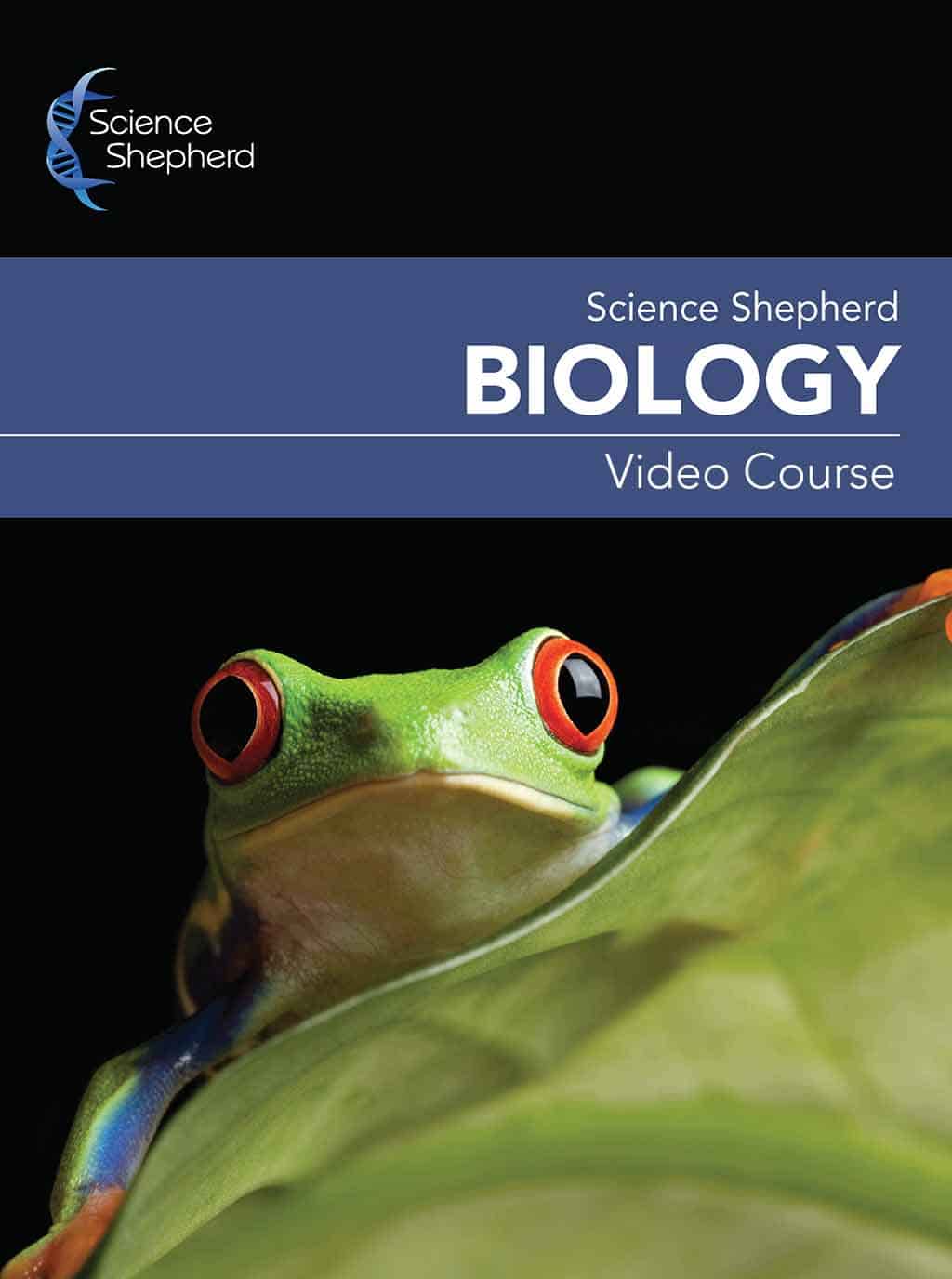
Wondering if Science Shepherd's Biology is right for your family? Check out our free preview! It provides access to multiple video lessons, including a lab, chapter review quiz, and additional PDFs.
Science Shepherd's homeschool Biology curriculum is a comprehensive and integrated college-prep course for high school, incorporating textbook, optional video-based lessons, lab manual, supplementary parent/teacher informational guide book, and test materials. Written by physician and homeschool dad Scott Hardin, MD, Biology was designed for independent study with advanced concepts presented in an easy-to-learn format. With the supplementary teacher information, parents can be involved in their student's learning without needing to be an expert in the material.
Science Shepherd Biology was awarded the 2015 Practical Homeschooling Science Reader Award, is one of Cathy Duffy's 103 Top Picks for Homeschool Curriculum, and receives rave reviews from families. You can be confident that our homeschool biology will provide an excellent educational experience to your student.


The short answer is that the materials included with the video series can stand alone, but the optimal learning experience will not be attained without the textbook; however, there are nuances to that answer that deserve explaining. I have no doubt that if the video alone is utilized, your student will receive a most excellent learning experience, equal to/better than that of the other video-only based high school biology programs out there. The nuance in the answer is that it depends upon what you and your student’s goal is for learning biology. If the goal is to ensure a solid experience for someone who struggles with science and isn’t going to pursue too much further learning in the biological sciences, then the video only approach will absolutely achieve that goal. On the other hand, if the student is highly interested in biological science and/or wants to pursue it further after this class, then, while the video itself is “complete” in that all of the material in the text is presented in the video, the video alone will not provide adequate ability for the student or teacher to assess the completeness of understanding of the material. I think the ideal way to learn this material is to both read and hear it (students who are challenged with text-based learning often do quite well with the text after watching the information first presented visually), with the text ultimately serving as a ready reference should a question arise (in which case trying to find the relevant material on one of more than 130 video clips amassed over more than 40 hours of video will be quite challenging). In addition, the end of chapter questions in the book are designed to test complete mastery of the subject matter (and they are ideally set up for both text-based learners and auditory learners) since they are true-false and short answer questions. This is, by far, the most thorough way to assess your student’s understanding of the material (as opposed to multiple choice or fill in the blank). If the video series is used alone, this valuable knowledge testing resource will be lost. Now, it is true that I have developed multiple choice questions that are integrated into the video series and learning platform but, again, they are really designed as a supplement for, rather than a substitute of, the questions in the text itself.
The 3rd Edition, Revised of Biology includes almost exclusively updates to the graphics. There are a few minor rewrites for clarity, but otherwise the text remains unchanged from the 3rd Edition. The textbook is softcover, rather than hardcover.
This is a somewhat difficult question to answer with 100% accuracy since there is no specifically defined “AP®” or “CLEP®” approved program; rather, in the case of the AP® program, the company provides a syllabus around which a teacher designs their specific AP program. When I review that syllabus (many different AP syllabi are on the web and you will find them by searching “AP biology syllabus”, or the recommended AP® Biology content), I find that our program covers 100% of what the AP® syllabus recommends be covered, as well as all of the recommended topics students should learn for the Biology CLEP®, with the exception of in-depth treatment of evolutionary concepts. Noteworthy is that when I developed our program, I had 10 high school, including Campbell’s and Miller-Levine (“The Lion Book”) and 1 introductory college texts with which to gauge ours, and I developed ours to specifically contain as much in depth, but none of the distracting side-bar, material as the most comprehensive of the texts. So, in that regard, I believe that our Biology covers a significant portion, if not all, of the non-evolutionary topics upon which the AP® and CLEP® tests measure the students (again, with the exception of evolutionary concepts). Science Shepherd Biology covers some of the evolutionary tenets, but not in as great detail as the evolutionary-based texts and so your student would need supplementary material in that regard. I should also note that the AP® program focuses extensively on students not memorizing facts, but learning about biological principles and how they interrelate. That concept is one of the driving forces behind how I designed the material presentation and wrote the end-of-chapter and test questions. There are no fact memorization processes in our program. I want the student to learn Biology, not to regurgitate stuff without any knowledge as to why they know what they know. In that regard, both the AP® concept and our programs share a common thread.
Since these are science courses that were written by a Christian, probably the most common question I am asked is, “What about evolution and creation?” The answer really starts and ends with the Bible. It is the unerring Word of God and, as such, provides the framework upon which everything is understandable, including science. The creation/evolution discussion starts with the assumption that God’s Word is true and everything flows from there. As such, all Science Shepherd material is presented from a literal understanding of Genesis, teaching that God created the universe and everything in it in 6 literal, 24-hour days, about 6,000 years ago. Now, why evolution in Christian-based courses? It is important to cover evolution and some basic principles because our children will be constantly bombarded with it throughout their lives. It is everywhere – in history, sociology, modern culture and even business economics. I think it is clear that the enemy has used and will continue to use evolution as the single most powerful tool to fight against God’s Kingdom. Our children need to be prepared for this battle and I hope our courses can help achieve that. Both Life Science and Biology start by presenting basic science concepts to serve as the foundation upon which the creation and evolution chapters are based. In these science chapters, I present the science only, since the science is the science regardless of how it got to be that way. This allows me to develop deep scientific concepts straightforwardly and cover a lot of ground efficiently. Once students are on scientific solid footing, the origins discussions ensue, which serve as the centerpieces of both texts. God’s Word takes main stage, providing the lens through which scientific data is interpreted, since that is the only way to truly understand the gift God has given us over which to take dominion. All throughout the creation and evolution discussions, God’s Word is juxtaposed with the views of various atheist and agnostic scientific academicians so that it is clear that evolution is not science, but its own origins faith. Using the Bible as THE source of truth when studying science is the only way to fully understand the miracle of life. The discussion is really a look at the tenets of creation and evolution and then measuring the scientific data with theologically sounds principles. God’s Word is true and is relied upon time and time again as THE way to understand science through the origins debate. We objectively learn that, time and again, as fully expected since the Bible is true and accurate, the creation model is supported while the evolution model is not. And, the discussions are not some fluffy look into creation and evolution. These are very complex discussions dissecting where – and perhaps more importantly, why – the evolution model fails to explain and is often directly contradicted by the scientific data. I wanted to teach the students not what to think, but how to think about creation and evolution, ultimately for them to produce a rather devastating argument for why they believe what they believe. That is a lot easier when one understands the perfect correlation between God’s Word and science. It is not my intent to provide a “compare and contrast” discussion, but it is inevitable. The evolution model is found lacking and time after time we see that the scientific predictions of the creation model are what are observed. The data clearly fit the creation model; there is no conflict, and a major theme in the creation/evolution discussion is that is what we would expect since God’s Word is true.
Not sure if the Free Preview: Biology is right for you? Our "Recommended Course Progression" can help you find the right homeschool science material for your family.
Subscribe to our newsletter and we'll send you a code for 10% off an order
plus a free download of 5 Scientific Ways Your Kids Can Defend Their Faith.