
My children are sad to be done with your Introductory Science course. So am I! It made science so easy this year!
Mrs. L.
It is absolutely no wonder to me that you received this award. I have found your high school biology amazing.
Sami W. and Children
Just wanted to drop a quick note and say how much we are enjoying the Life Science curriculum. Hands down, it is the best program out there.
Ellen K.

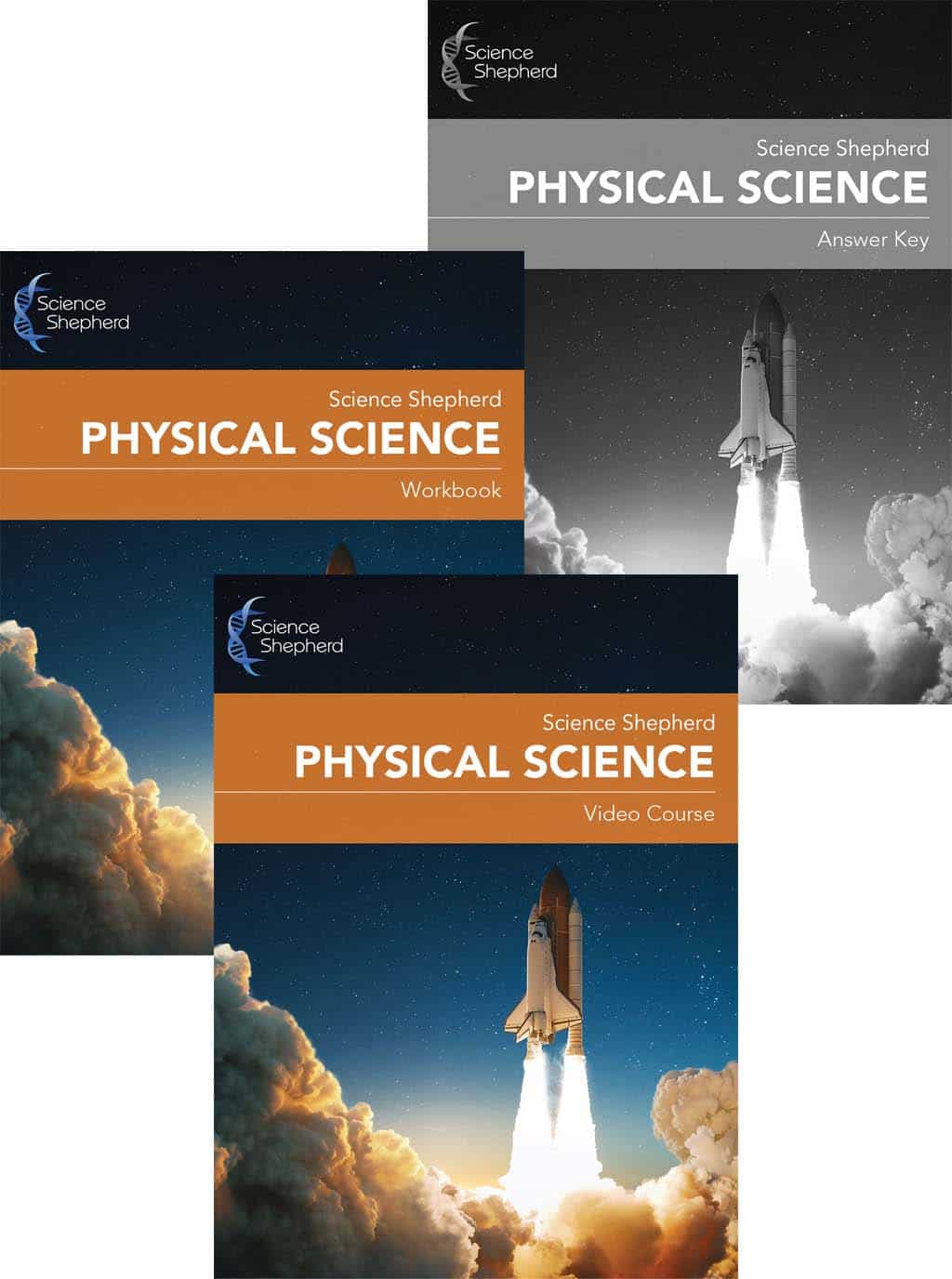
Science Shepherd’s Physical Science homeschool curriculum builds upon the basic principles established in our Introductory Science. The straightforward and engaging course focuses on foundational principles of chemistry, physics and astronomy including atoms, molecules and bonding, the Periodic Table, forces, the solar system and more. Physical Science was written by Dr. Scott Hardin, a physician and homeschool dad.
The Physical Science Video Course features over 100 video lessons, available via online streaming or a DVD set (yours to keep), presented in an easy to follow, and easy to adjust, 35-week schedule with 3 lessons per week. Each lesson provides clear explanations and supporting visuals, and is easily accessible for elementary and middle school learners alike.
In addition to the Physical Science Video Course, students complete workbook assignments to reinforce key concepts taught in each video lesson. Two levels of the Physical Science Workbook are available - Level A or Level B - to help you tailor the learning experience to each student. Physical Science Workbook Level B contains all of the same material as Physical Science Workbook Level A, plus additional content for older students. All of the video lessons are the same for each workbook level, so students in both levels can watch each lesson together.
These grade/age recommendations are flexible and meant only as guidelines. Please choose the level you feel is best for your individual learner, considering his or her reading level and critical thinking (and a little bit of math). Students in Level B will need to be able to perform basic two-digit-number addition and subtraction. The free course preview and Workbook samples can also help you choose the appropriate Level (see below).
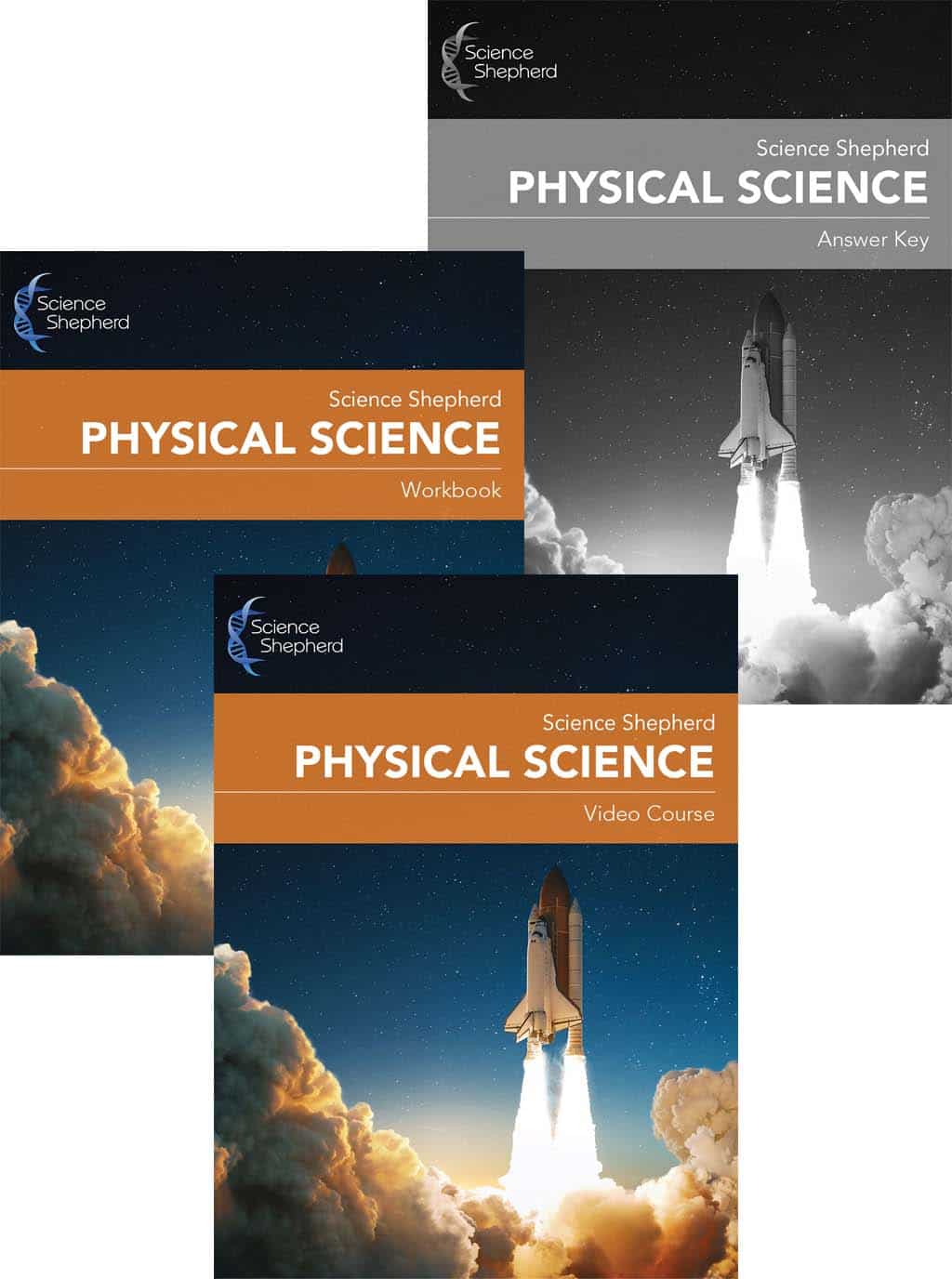
Enrolling multiple students? If need Level A and Level B material simply purchase a Physical Science Bundle and add additional Workbooks and an Answer Key as needed.
Science Shepherd was awarded the Practical Homeschooling 2023 and 2024 Elementary Science Reader Award, is a 2022-2025 Homeschool.com Educational Website Awards Winner, and receives rave reviews from families. You can be confident that our Physical Science homeschool curriculum will provide an excellent educational experience to your student.


Watch a sample lesson video below, or access a free preview of our Physical Science homeschool curriculum through our online student learning portal. The preview includes 4 complete lesson videos and the corresponding pages for Workbook Level A and Level B so you can easily compare and select the right Level for your student.
Ready for an introduction to physical science? Save 10% with the homeschool Physical Science bundle!
Hi. Welcome to Science Shepherd Physical Science, where we'll learn about chemistry, physics, and astronomy. It may seem a little strange to group those three subjects together into the same class, but physical science is all about the way that nonliving things are structured and how they interact. It's really all a matter of scale between the three sciences. In general, physics is a study of how objects that we can usually see and feel move and interact with each other. Chemistry is the study of how really, really tiny stuff, like individual atoms and molecules, interact. And astronomy is the study of how really huge stuff, like planets, stars, and galaxies interact. So making them in the same class makes a little bit more sense than it might seem at first. And like in all of our classes, I wanna make sure that we acknowledge and give glory to the one who made everything possible, God. He created the universe and everything in it. And throughout the Bible, we learn how powerful and smart God is. The very first line of the Bible in Genesis one one says, in the beginning, God created the heavens and the earth. Now it may seem very simple, but that line tells us that God is how everything came to be. And when you consider what that says a little bit deeper, Genesis one one also says that God created time, space, and matter. By the way, matter is just the fancy science word for stuff. Planets, stars, trees, people, and water, anything that you can see or feel is matter. We'll be talking a lot more about matter soon, though. So before God said, let there be light, there was only God. Then in six days, he created the universe and everything in it. People who believe that God created the universe and everything in it, just like the Bible describes, believe in creation or the creation model of origins. Origins just means where everything came from. So scientists that believe that God created everything by speaking the words let there be, just like Genesis says. But there's another way that people use to explain origins or where everything in the universe came from, and that idea is called naturalism. In the naturalism model of origins, god didn't create anything. In fact, he doesn't even exist in the naturalism model. Naturalism says that everything came to be accidentally, really that the universe created itself. Those two models are very different, aren't they? Either God created everything or nature just created itself. Now, even though these two models are very different, some scientists do try to make parts of the naturalism model fit into the creation model. But that doesn't really work because the entire reason that scientists made up the naturalism model was to explain how everything got here without God. Since there are these two different scientific models to explain where everything came from, from time to time in our class, I'll talk about what the science we are learning about says about each model. Because one of the most important things to know about anything is that there is a huge difference between facts and how facts are interpreted. When a fact is interpreted, that means that someone tells you what they think it means. When it comes to science, how a fact is interpreted depends one hundred percent on if you believe the creation model or if you believe the naturalism model. So it's possible to have two scientists look at the exact same fact and give you a very different interpretation about what that fact tells us. How can that be, though? Isn't science all about facts? Well, yes and no. Science is all about uncovering facts and then trying to figure out what the facts tell you. Let's use an example to see that difference between a fact and what the fact means. This football scoreboard tells us that the lizards beat the hippos thirty two to three. That's the fact the lizards scored thirty two points and the hippos scored three. So the lizards won and the hippos lost this game. I ask you to tell me what that fact means to you by telling me if that score is good or bad. Well, your interpretation of this fact completely depends upon which team you like. If you're a lizards fan, then you will tell me that the factual score of thirty two to three is good because your team won. However, if you're a hippos fan, you'll tell me that the factual score of thirty two to three is bad because your team lost. Or maybe you don't even like football and couldn't care less who won, and so you can't say whether it's good or bad, which is yet a third interpretation of the exact same factual score of the football game. This same exact thing happens in science all the time, and the interpretation of facts depends completely on if a scientist believes in the creation or the naturalism model. A scientist who believes in creation will look at a fact and interpret it very differently than a scientist who believes in naturalism. And throughout the year, we'll occasionally explore these differences because it is ultimately the responsibility of the one who receives the interpretation, you, to make an informed determination of which interpretation of a given fact is correct. Fortunately, there are ways of doing that. As an example, this is a fossil of a dinosaur, which the creation model interprets as being about four thousand years old since the majority of fossils in the creation model were created in Noah's flood. The naturalism model interprets this fossil as being sixty five million years old. The fossil is the fact and the age is the interpretation. How to decide which is correct is the fossil four thousand years old or sixty five million years old? Well, we can make ourselves a little bit smarter so that we can make a better determination of which age is correct by looking at other facts about the fossil to see if they support one interpretation or the other. One of the other fascinating facts about this fossil and many, many others is that it still has soft tissue, which is stuff like intestines, liver, blood cells, and connective tissue. Anything that isn't bones or teeth is soft tissue. In fact, that loop that we're looking at is that dinosaur's actual intestine. The thing about soft tissues is that we know they don't last very long. Even mummies that are preserved to keep their soft tissues intact for as long as possible have pretty pathetic soft tissues and they don't even and they haven't even been exposed to wind and rain and weather like fossils have. So the difference between sixty five million years and four thousand years is huge when you're thinking about soft tissue. Scientifically speaking, we know that soft tissues can't last sixty five million years because they break down way before that. So if this specimen really is sixty five million years old, it should not have any soft tissues left. They should have been degraded long, long ago. However, if it's four thousand years old like the creation model proposes, then it could have soft tissues. So when we're trying to figure out what a fact tells us, our interpretation must be consistent with other facts about the science. In this case, the fact that this fossil still has soft tissues strongly argues against it being sixty five million years old, while at the same time it agrees with it being four thousand years old like the creation model says. However, my main goal for this class is to clearly teach the science and that science, the observable facts, exist as they do whether you believe in creation or naturalism. But from time to time, really interesting discussions can be had when interpreting the same facts through the creation and naturalism models. Also, at the end of each class, I'll go through the key ideas from from that class for the day. So here they are for today. This class is all about the physical sciences of chemistry, physics, and astronomy. Physical sciences study how matter moves and interacts with other matter. There are two ways to scientifically explain where everything in the universe came from, the creation model and the naturalism model. The way that anyone decides what a scientific fact means depends on if he or she believes in creation or naturalism.
The Video Course for Physical Science is the exact same for Level A and Level B. Only the Workbooks differ for the two Levels, with Level B being slightly more challenging (more questions, and questions worded differently).
No, Physical Science does not have any tests or quizzes.
Since these are science courses that were written by a Christian, probably the most common question I am asked is, “What about evolution and creation?” The answer really starts and ends with the Bible. It is the unerring Word of God and, as such, provides the framework upon which everything is understandable, including science. As such, all Science Shepherd material is presented from a literal understanding of Genesis, teaching that God created the universe and everything in it in 6 literal, 24-hour days, about 6,000 years ago. Now, why evolution in Christian-based courses? It is important to cover evolution and some basic principles because our children will be constantly bombarded with it throughout their lives.
Looking to plan a few years in advance and have your next topic selected? The astronomy section of Physical Science lays the groundwork for our more robust Astronomy: God's Universe. You can also read our recommended homeschool science progression for a broad overview of utilizing Science Shepherd curriculum in your homeschool.
December 29, 2025 5 min read
Science for 7th grade.
December 20, 2025 5 min read
Homeschool science for 6th grade.
Subscribe to our newsletter and we'll send you a code for 10% off an order
plus a free download of 5 Scientific Ways Your Kids Can Defend Their Faith.